

Product design
Biofuels compliance product
Streamlining document ingestion for compliance traceability in the Biofuels supply chain.
Product details
🎯 Summary
To meet the complex demands of sustainability compliance in the biofuels industry, I redesigned the document ingestion system of a compliance platform to support dynamic, diverse regulatory documents (e.g., ISCC EU, RED II). The goal was to replace fragmented, location-specific forms with a universal, scalable ingestion interface capable of adapting to evolving document formats with minimal developer effort.
💊 Problem statement
The legacy system required users to upload and enter details for sustainability documents (e.g., supplier declarations, delivery notes, CoA, mass balance proofs) through distinct UI forms per document type. This siloed and manual approach led to:
-
High maintenance burden for tech teams adding new forms
-
Long user onboarding and training cycles
-
Limited scalability across regions and supply chains
-
Risk of errors or inconsistencies in regulatory data capture
Given the regulatory stakes, where non-compliance could result in loss of trading licenses or financial penalties; the team needed a more flexible, scalable, and efficient way to ingest and process varied sustainability documents while maintaining high traceability and audit readiness.
🎻 Role and team
My role: Design Lead embedded in the Discovery Team alongside Product and Tech Leads
-
Collaborated closely with the tech lead and document processing team
-
Led the IA, information design, and interaction design
-
Facilitated solution prototyping and alignment with compliance SMEs
-
Conducted secondary research on document ingestion methods such as base64.ai.
🧠 Approach
Instead of designing unique forms for each document type, I proposed a semi-structured ingestion model that leverages backend document parsing, pattern recognition, and intelligent field labeling.
Key design activities included:
-
Benchmarking semi-structured input UIs from logistics, finance, and procurement platforms
-
Modelling document variance across markets (e.g., EU RED II, ISCC, country-level taxonomies)
-
Designing a unified upload UI with visual segmentation of parsed documents
-
Defining interaction patterns for:
-
Field recognition
-
Label editing and reclassification
-
Confidence indicators for extracted values
-
Flagging missing mandatory fields
-
-
Building interactive prototypes to validate feasibility with developers
-
Structuring metadata tagging for downstream document generation
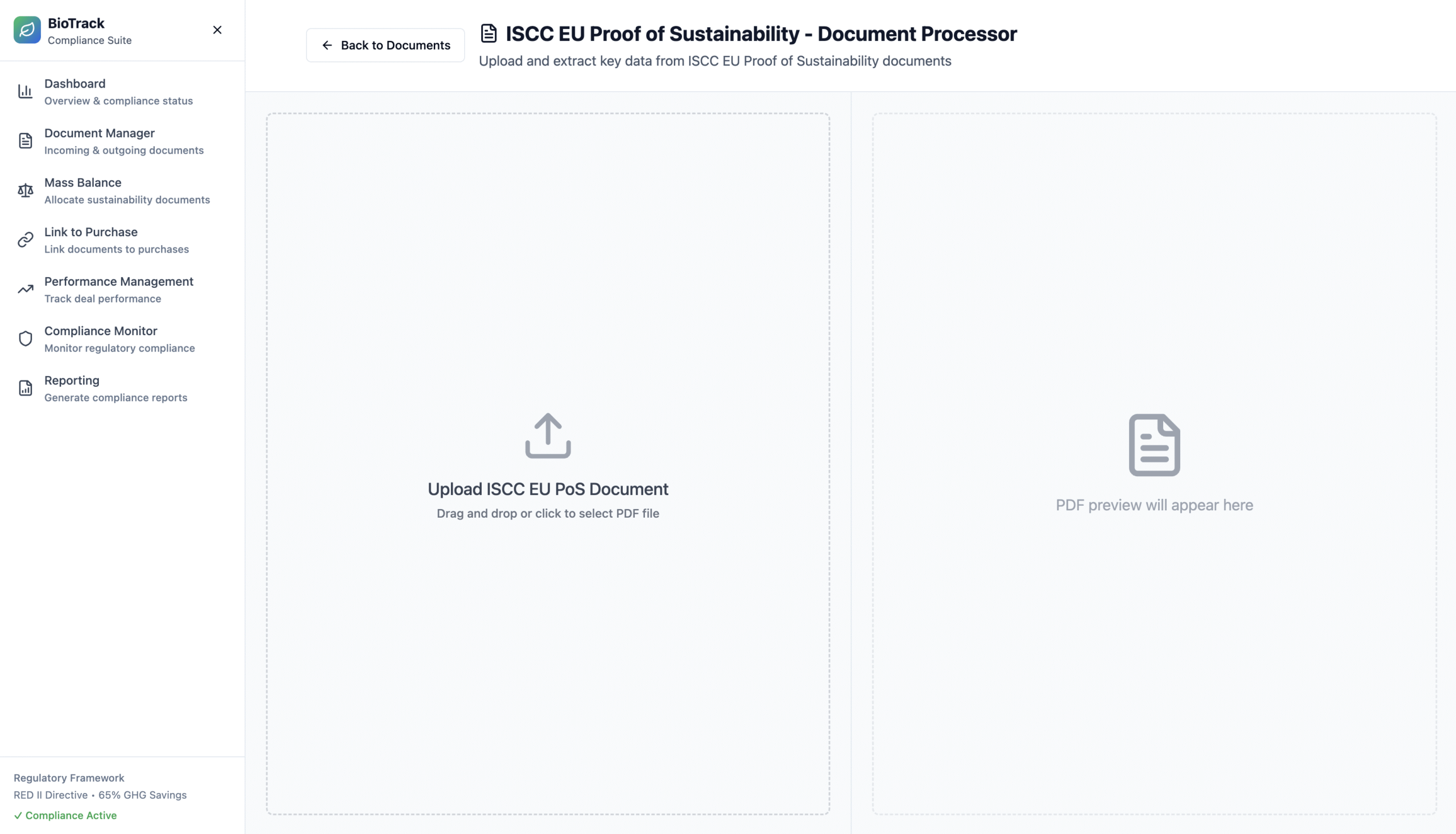
- Below is a sample screen shot of the design
😓 Challenges
-
Complexity of regional regulations meant documents varied significantly in layout and language
-
No access to end users for primary research; relied on compliance SMEs and internal auditors
-
Ensuring the system could adapt to new document templates without requiring frontend redesigns
-
Balancing automation with human oversight to avoid false positives in compliance-critical data
👌🏼 Solution
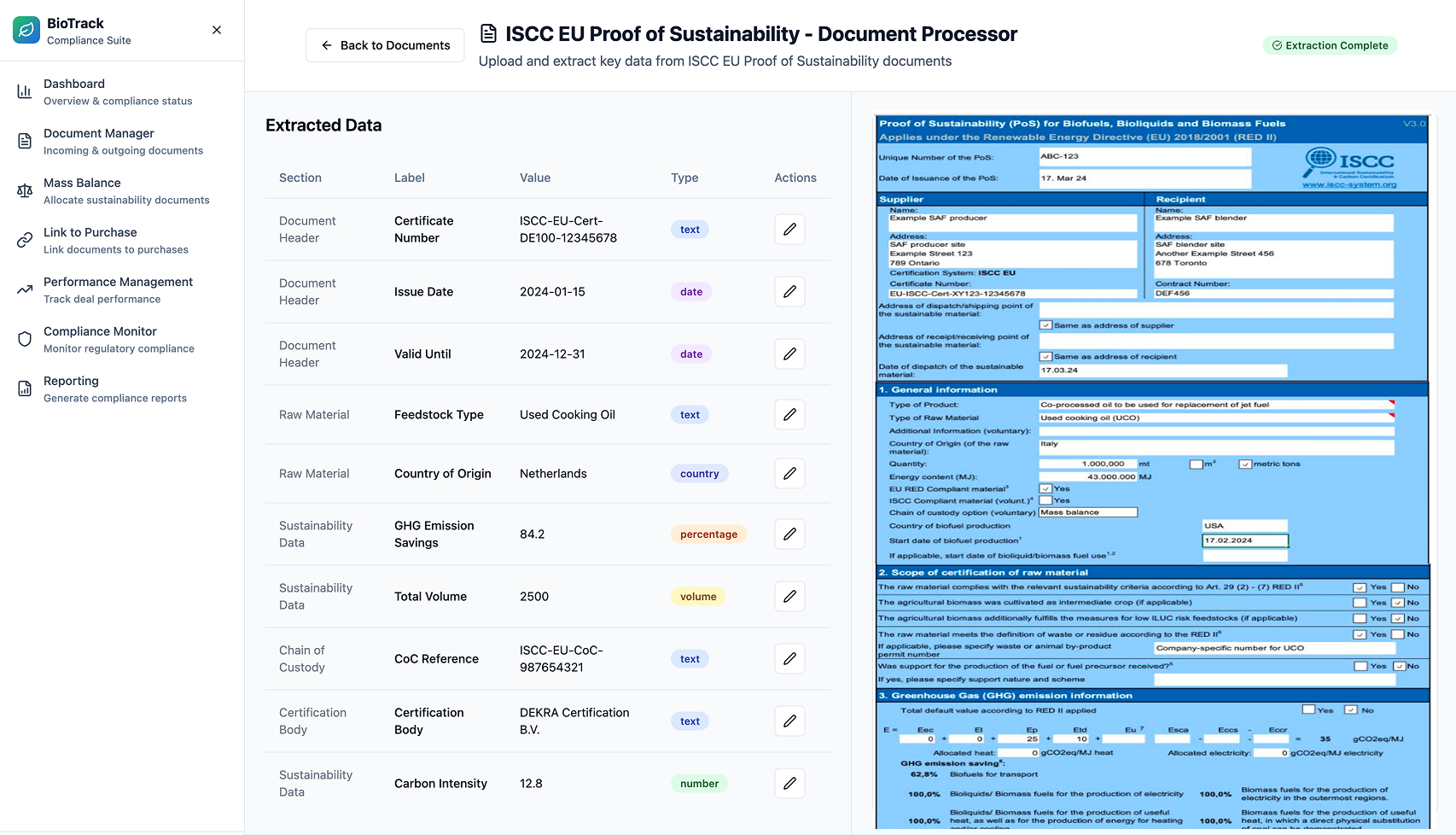
I delivered a modular semi-structured document ingestion UI that:
-
Presents uploaded PDFs in a side-by-side format with editable data fields
-
Auto-classifies sections (e.g., “Origin declaration,” “Mass balance summary”) using layout + keyword detection
-
Allows users to label new fields, adjust values, and add metadata with contextual help
-
Displays a compliance confidence score and alerts for incomplete fields
-
Stores ingest rules as backend config, allowing new document types to be added without UI changes
Visual design emphasized clarity, hierarchy, and progressive disclosure, tailored for operations teams working under regulatory pressure. I documented UX patterns and field mapping logic for developer handoff and future extensions to outgoing document generation.
Results & Impact
(Estimated)
Even without direct user metrics, we looked at measurable internal improvements:
-
50% reduction in frontend development time for new document types across markets
-
~40% decrease in support tickets related to document entry errors
-
30% faster user onboarding due to consistent UI and smart defaults
-
Improved audit readiness, with traceability fields now consistently populated
-
Created a scalable ingestion model that supports future automation via AI/ML parsing
The solution helped ensure the product maintained regulatory compliance across jurisdictions while improving internal operational efficiency and reducing tech maintenance backlog.
Other products
Energy management
Role
Expereince design lead
Contribution
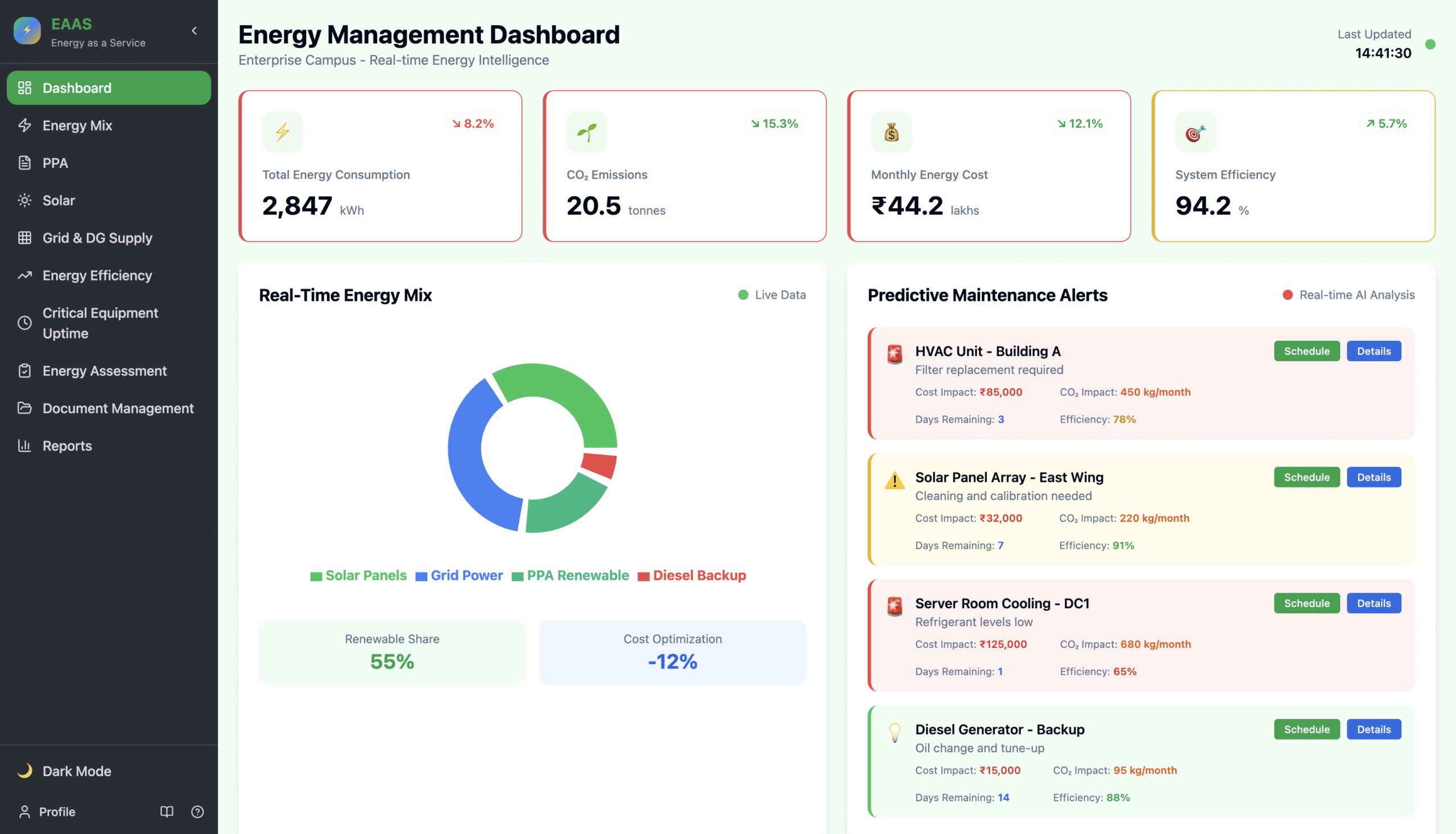
Lead the design team from partner company and conceptualised the entire design of this modern energy management platform.
ML Ops data platform
Role
Head of Product Design
Contribution
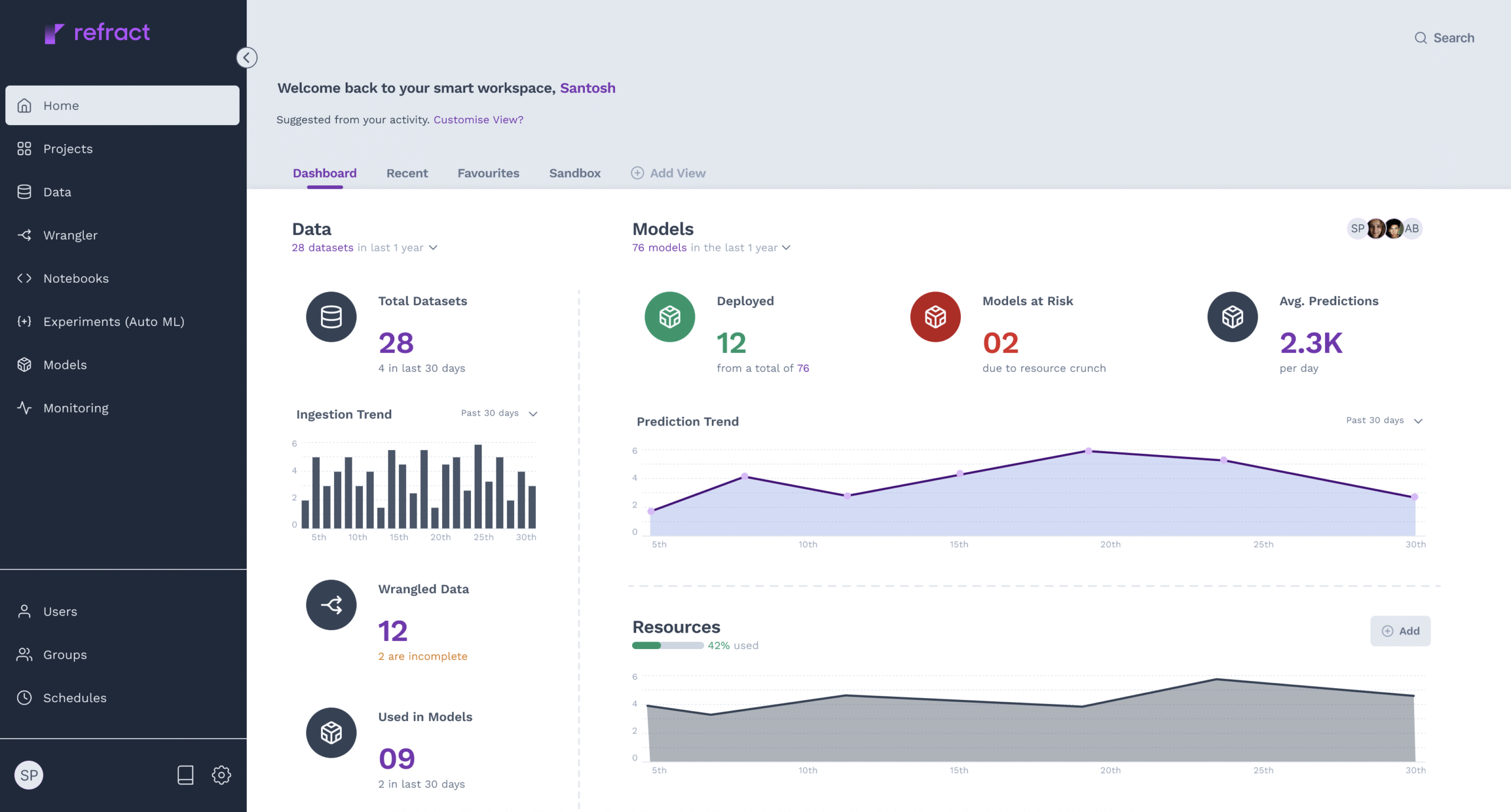
Built the design team, conceptualised the redesign of this modern ML ops data platform based on UX audit and workflow issues.